Everything in Forkluck
Six parts, one workspace. A recipe, what it costs to buy, what it costs to make, and what it sold for, all in the same place, so the numbers agree with each other.
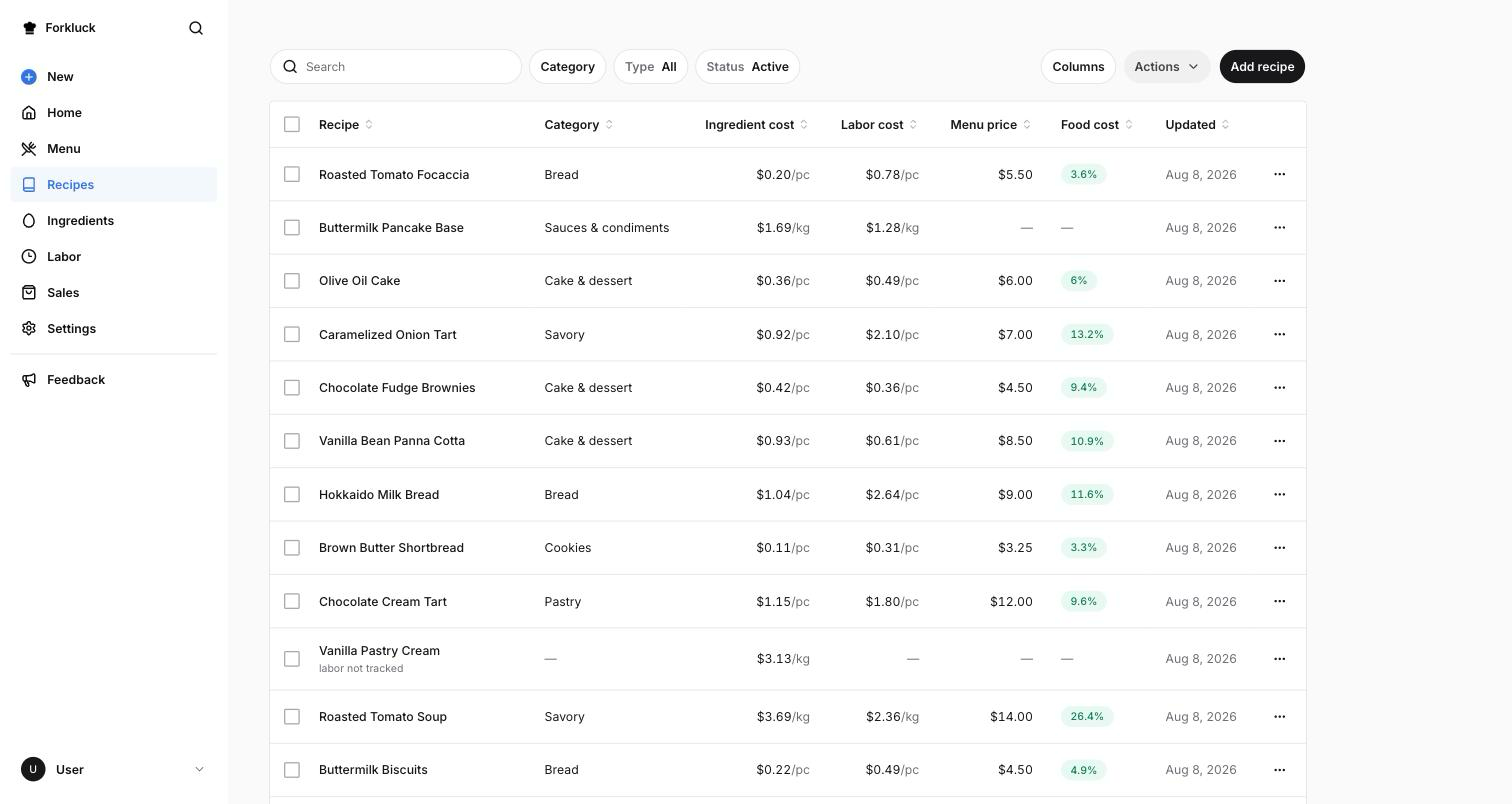
Recipes & formulation
Paste a recipe as you'd write it. Lines like 620 g Flour are read into a quantity, a unit and an ingredient, metric or imperial, and costed against your own prices as you type.
For bread and pastry, the formulation panel keeps up: baker's percentages, hydration, dry matter and salt, recalculated on every keystroke, with the bread benchmark of 65–85% water against flour weight shown alongside so you can see when a dough is out of range.
Every recipe also carries a nutrition label with allergens (the US label and the EU allergen list), built from the ingredients you already entered.
Ingredients & prices
Ingredients are priced the way you buy them: pack size and pack price, with the unit price derived from the two. Change a supplier or a case size and the history keeps both, so you can see what a price did over months rather than only what it is today.
Bring prices in from a purchase report, or let Claude read a supplier invoice as a PDF or photo and turn it into priced lines you approve. Invoice reading runs on your own Anthropic API key, which you add in settings.
Prices can be in USD, EUR, GBP or CAD; Forkluck converts with the ECB's daily reference rates and keeps your workspace currency consistent throughout.
Menu & sales
Connect Square or Shopify and sales land on your products. Refunds, discounts and modifiers are handled in the sales ledger rather than averaged away, and a bundle is split back to the products it contains, so a combo doesn't quietly credit itself.
With cost on one side and sales on the other, each menu item gets a class from its margin and its popularity: Star, Plowhorse, Puzzle or Dog. It's an old piece of menu engineering, and it still tells you which plate to reprice and which to cut.
Labor
Import timesheets and set the two numbers that make labor real: the weekly overtime threshold, and the payroll burden percentage on top of wages.
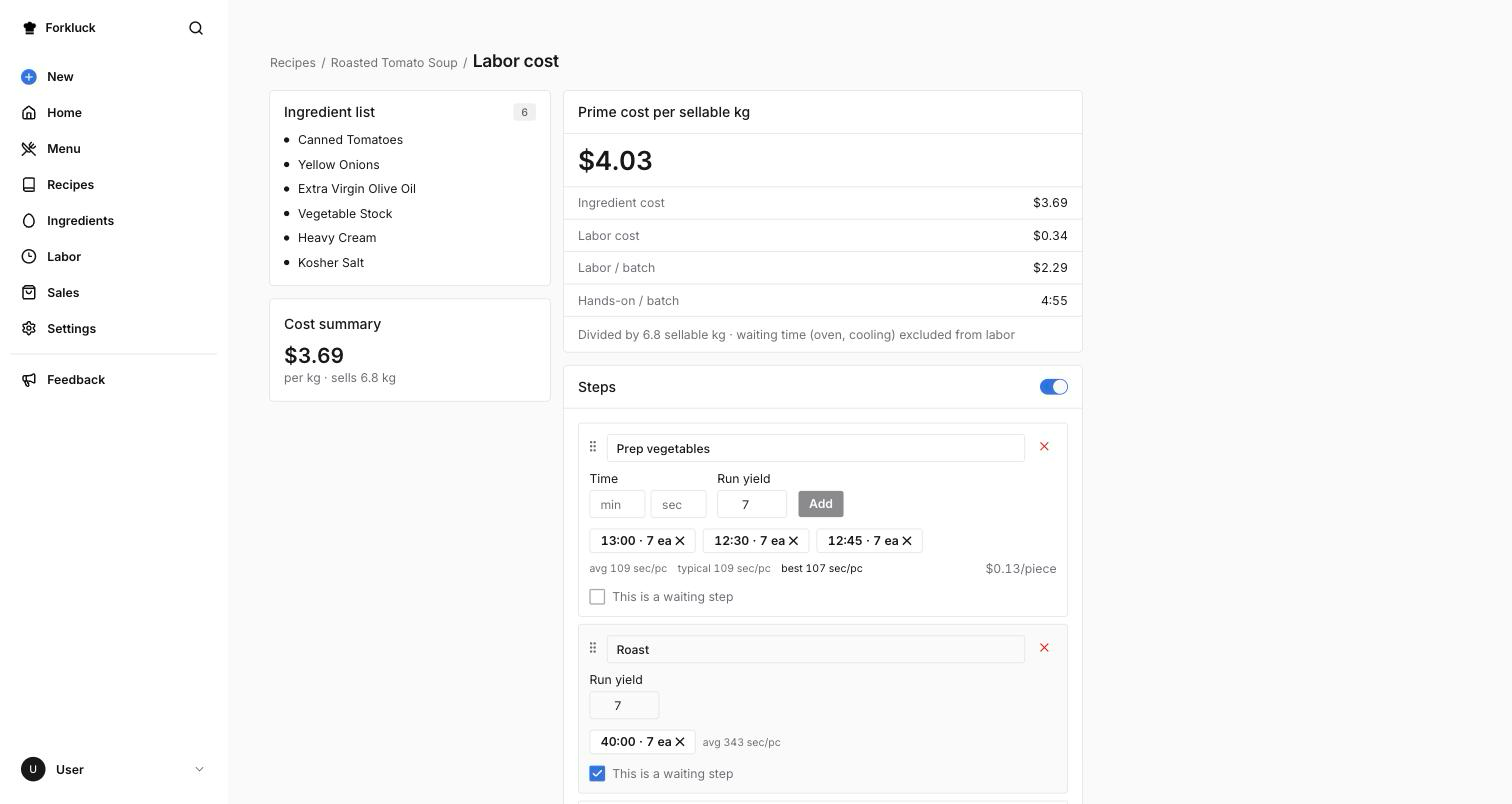
Time production steps as you work them, and Forkluck uses the median so one bad shift doesn't set your cost. Labor then lands per batch and per portion, and sits inside prime cost next to food.
Forecast & insights
Net sales, prime cost and price movement, each against a comparison period you choose: the prior week, or the same week 52 weeks ago. Price moves are computed on unit price, so a switch from a 10 kg sack to a 25 kg sack doesn't read as inflation.
For any saved menu, Forkluck forecasts demand from your own sales: for each product it takes the four prior matching weekdays and builds the baseline from those, so a Saturday is compared to Saturdays.
Private by design
Your recipes are never published, never indexed and never pooled with anyone else's. When you want to share one, you make a guest link. Forkluck stores only a hash of that link's token, so the link itself exists in your hands and nowhere else.
Start costing your menu
Get started or sign in.